

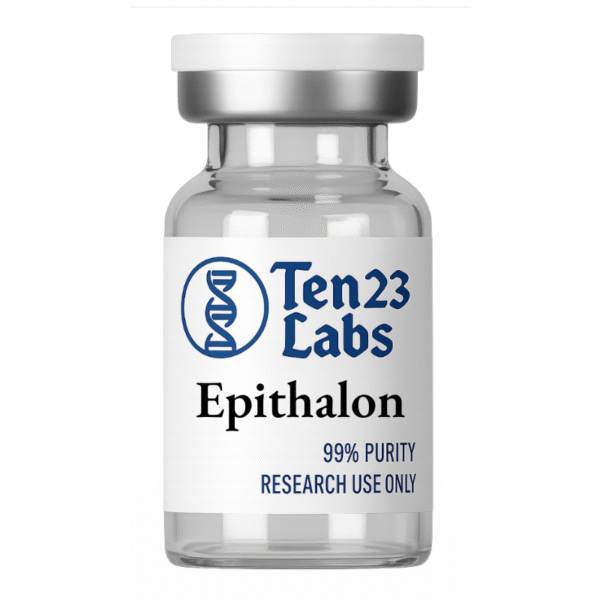
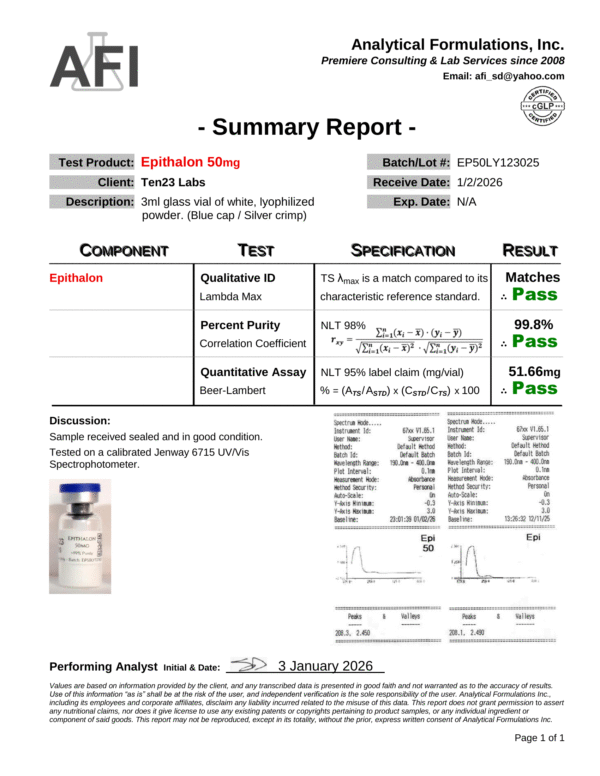
🧬 Epithalon (Epitalon / Epithalone) – Research Overview
0. Category:
Anti-Aging / Longevity, Cellular Regeneration, Sleep Optimization, Immune Support, Metabolic Health
1. Primary Research Use:
Epithalon is primarily researched for its role in telomere regulation and cellular aging, with additional studies exploring its effects on sleep quality, circadian rhythm normalization, immune function, and overall healthspan extension. It is one of the most extensively studied longevity peptides in Russian biogerontology, with over three decades of research across cell cultures, animal models, and limited human trials.
2. Simple Analogy:
Think of Epithalon as a cellular retirement extender. Every cell has a built-in clock that tells it when it’s time to stop dividing. Epithalon doesn’t make cells immortal—it simply allows them to stay productive and healthy a little longer before they clock out.
3. What It Is (Chemical Summary):
Epithalon is a synthetic tetrapeptide composed of Alanine–Glutamic Acid–Aspartic Acid–Glycine (AEDG). It was developed in the 1980s by Professor Vladimir Khavinson based on epithalamin, a naturally occurring peptide isolated from the pineal gland. Despite its small size, Epithalon is capable of entering the cell nucleus and influencing gene expression related to aging and regeneration.
4. Best Suited For:
Epithalon is commonly researched by those interested in:
- Longevity and lifespan extension
- Preserving telomere length and cellular division capacity
- Age-related decline in sleep quality and circadian rhythm
- Immune system aging (immunosenescence)
- Overall healthspan optimization rather than short-term stimulation
It is often explored in aging populations or long-term biological aging models rather than acute performance use.
5. Not Recommended For / Caution In Research With:
Caution is advised when researching Epithalon in individuals with:
- Active cancer or history of telomerase-driven malignancies (theoretical concern due to telomerase activation)
- Pregnancy or breastfeeding, due to lack of safety data
- Severe endocrine disorders, unless under controlled study conditions
Although animal data suggests a favorable safety profile, long-term large-scale human data remains limited.
6. Synergistic Peptide Stacks:
- Thymosin Alpha-1 – Complements immune regulation and aging-related immune decline
- SS-31 – Supports mitochondrial structure and energy production alongside Epithalon’s nuclear-level aging effects
- DSIP – Pairs well for research into sleep quality, circadian rhythm, and nervous system recovery
- MOTS-c or NAD+–related compounds – Adds metabolic and mitochondrial resilience to telomere-focused protocols
7. Common Dosing Guidelines (Research Use):
| Experience Level | Common Dosage Range |
|---|---|
| Beginner | 5 mg daily |
| Intermediate | 5–10 mg daily |
| Advanced | Up to 10 mg daily |
Theoretical Research Protocol:
- Days 1-10: 5mg nightly
- Days 11-15: 10mg nightly
- Administered back-to-back (15 consecutive nights)
Doses are typically administered once daily in the evening, aligning with pineal gland and melatonin signaling research.
8. Cycling Information:
Research protocols almost universally use short, intensive cycles, most commonly:
- 10–20 consecutive days,
- Repeated 1–2 times per year
Epithalon is not designed for continuous daily use. The effects appear regulatory and long-lasting, persisting beyond the dosing window.
9. Similar Peptides & Comparison Chart:
| Peptide | Primary Mechanism | Duration of Effect | Dosing Frequency | Notes |
|---|---|---|---|---|
| Epithalon | Telomerase activation, gene regulation | Long-term | Cycled (annual) | Focused on aging clock & healthspan |
| Epitalamin | Pineal peptide extract | Medium | Cycled | Less specific, extract-based |
| SS-31 | Mitochondrial membrane stabilization | Short-medium | Daily | Structural mitochondrial support |
| MOTS-c | AMPK activation, metabolic signaling | Short | Weekly cycles | Exercise-mimetic metabolic effects |
10. Method of Administration:
Epithalon is most commonly administered via subcutaneous injection, typically in the evening. This route is consistent with nearly all longevity-focused research protocols.
11. Regulatory Status (FDA Approval):
Epithalon is not FDA-approved and is classified as an investigational research compound. While human trials have been conducted internationally—primarily in Russia—it is not approved for medical use in the United States or most Western jurisdictions.
12. Legal Disclaimer:
All products discussed are intended for laboratory, scientific, and research purposes only. Epithalon is not approved by the FDA for human or veterinary use and is not intended to diagnose, treat, cure, or prevent any disease.
The information provided is for educational purposes only and does not constitute medical advice. Always consult a licensed healthcare professional before making health-related decisions.
By accessing or purchasing these materials, you affirm that you are a qualified researcher or are acting under appropriate supervision. All sales are final.
Reviews
There are no reviews yet.