

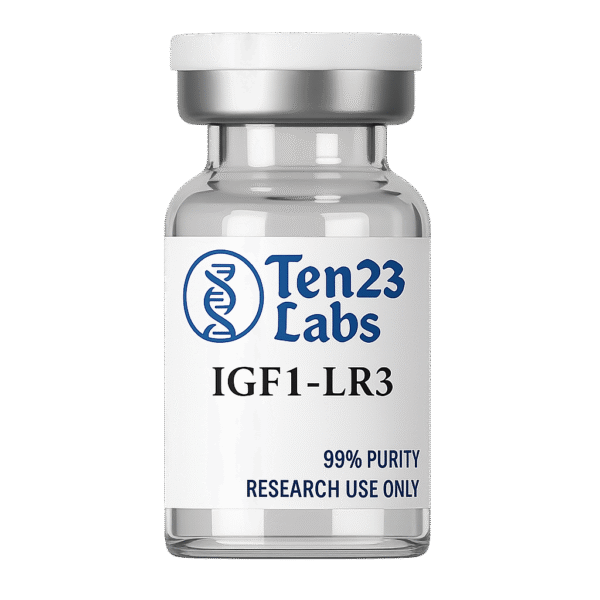
IGF-1 LR3 — Product Description
0. Category
Muscle Growth / Strength, Recovery & Repair, Fat Loss, Anti-Aging / Longevity
1. Primary Research Use
IGF-1 LR3 is primarily researched for its potent anabolic effects on skeletal muscle, including both hypertrophy (increased cell size) and hyperplasia (increased cell number). It is also studied for its roles in accelerating tissue repair, enhancing nutrient uptake into muscle cells, supporting fat metabolism, and promoting cellular growth and differentiation through sustained IGF-1 receptor activation.
2. Simple Analogy
Most GH peptides (like Tesamorelin, CJC-1295, or Ipamorelin) work upstream — they knock on the pituitary’s door and ask it to release more growth hormone, which then travels to the liver to produce IGF-1. IGF-1 LR3 skips that entire chain of command. It’s the end product itself, injected directly, and engineered to stay active 100x longer than the natural version by slipping past the binding proteins that would normally neutralize it within minutes. Think of it as bypassing the factory’s order system and delivering the finished material straight to the construction site — no waiting on approvals, no bottlenecks, no dilution along the way.
3. What It Is (Chemical Summary)
IGF-1 LR3 (Insulin-Like Growth Factor-1 Long Arg3) is a synthetic, 83-amino acid analog of native human IGF-1 (which has 70 amino acids). It features two key structural modifications: an arginine substitution at position 3 (replacing glutamic acid) and a 13-amino acid N-terminal extension. These changes dramatically reduce its binding affinity to IGF binding proteins (IGFBPs), resulting in a half-life of approximately 20–30 hours compared to just minutes for native IGF-1, and significantly greater bioavailability and potency.
4. Best Suited For
This peptide is commonly researched by those studying muscle hypertrophy and hyperplasia, post-exercise recovery and tissue repair, body recomposition, satellite cell activation, and age-related muscle wasting (sarcopenia). It is especially notable in preclinical models investigating direct anabolic signaling independent of growth hormone secretion.
5. Not Recommended For / Caution In Research With
Caution is advised when researching this peptide in individuals with:
- Active, suspected, or history of cancer — particularly prostate, breast, colorectal, or lung (IGF-1R activation promotes cell proliferation and inhibits apoptosis; this compound also bypasses the IGFBP system, which normally acts as a brake on unchecked growth signaling)
- Diabetes, insulin resistance, or hypoglycemia risk (IGF-1 LR3 has insulin-like glucose-lowering effects that can cause dangerous blood sugar drops, especially when fasting or underfed)
- Pregnancy or breastfeeding (no reproductive toxicology data exists)
- Pre-existing organ enlargement or cardiac conditions (prolonged use may promote visceral organ growth, similar to effects seen in acromegaly)
- Individuals under 25 with open growth plates (may cause abnormal skeletal development)
⚠️ 5b. Important Safety Warnings
Unlike upstream GH peptides (Tesamorelin, CJC-1295, Ipamorelin) that work with the body’s regulatory feedback loops, IGF-1 LR3 bypasses them entirely. It evades the binding proteins that normally regulate how much IGF-1 is active at any given time. This makes it significantly more potent — but also removes the body’s natural safety net. Researchers should be aware of the following:
Hypoglycemia (Primary Acute Risk)
IGF-1 LR3 shares structural similarity with insulin and directly increases glucose uptake into cells. Blood sugar drops can occur rapidly, particularly when dosing in a fasted state or with inadequate carbohydrate intake. Always administer with or shortly before a meal. Symptoms include dizziness, shakiness, sweating, confusion, and in severe cases, loss of consciousness.
Cancer / Tumor Promotion Risk
Elevated IGF-1 signaling is epidemiologically associated with increased risk of several cancers. IGF-1 LR3 raises particular concern because it not only activates growth pathways but also sidesteps the IGFBP system — which independently has anti-proliferative and pro-apoptotic (tumor-suppressing) functions. Anyone with a personal or strong family history of cancer should avoid this compound.
Organ and Tissue Overgrowth
Chronic supraphysiological IGF-1 signaling can produce effects resembling acromegaly — enlargement of internal organs (heart, intestines, kidneys), thickening of soft tissue, and bone growth in the hands, feet, and jaw. This risk increases with higher doses and longer cycles.
Insulin Resistance (Long-Term Risk)
Prolonged use can push the body toward insulin desensitization, undermining metabolic health over time — the opposite of what most researchers intend.
No Human Clinical Trial Data
Unlike Tesamorelin (FDA-approved, extensively studied in humans), IGF-1 LR3 has no published human clinical trials. Safety profiles are derived from preclinical models, mechanistic reasoning, and anecdotal reports. This is not a well-characterized compound in humans.
Mandatory Monitoring
Any research protocol should include regular blood work — at minimum glucose/insulin levels, IGF-1 levels, and basic metabolic panels — particularly during the first 2 weeks and throughout the cycle.
6. Synergistic Peptide Stacks
- MGF (Mechano Growth Factor) – Alternating protocols leverage MGF’s satellite cell activation followed by IGF-1 LR3’s sustained growth signaling, mimicking the body’s natural repair-then-build sequence.
- CJC-1295 / Ipamorelin – Upstream GH secretagogues can elevate endogenous GH, complementing IGF-1 LR3’s direct receptor-level anabolic action.
- BPC-157 / TB-500 – Supports connective tissue healing, tendon repair, and inflammation reduction alongside IGF-1 LR3’s muscle-building effects.
7. Common Dosing Guidelines (Research Use)
| Experience Level | Common Dosage Range |
|---|---|
| Beginner | 20–40 mcg per day |
| Intermediate | 40–80 mcg per day |
| Advanced | 80–100 mcg per day |
Half-life: ~20–30 hours. Each dose stacks on residual activity from the prior day, reaching steady-state accumulation within 4–5 days. Dosing is in micrograms (mcg), not milligrams — the compound is highly potent at small amounts.
Dosing frequency options:
- Daily – Maintains stable levels; best suited at conservative doses (20–50 mcg) to manage accumulation and hypoglycemia risk.
- Training days only (4–5x/week) – Reduces cumulative exposure while capitalizing on the post-exercise window when IGF-1 receptor sensitivity is elevated. A common middle-ground approach.
- Every other day – Viable given the long half-life; minimizes desensitization risk during longer research protocols.
Timing: Post-workout (within 30 minutes of training) is preferred to align with exercise-induced receptor upregulation. On rest days, morning administration is typical.
8. Cycling Information
Research protocols often suggest 4–6 week cycles, followed by a 4–6 week washout period to prevent receptor desensitization. Continuous use beyond 8 weeks without a break is generally not recommended due to limited long-term data and potential for receptor downregulation or insulin desensitization.
Common protocols:
- Standard: 4–6 weeks on, 4–6 weeks off
- Conservative: 4 weeks on, 4 weeks off
- Training days only administration is also used to extend effective cycle length
9. Similar Peptides & Comparison Chart
| Peptide | Duration | Mechanism of Action | Dosing Frequency | Notes |
|---|---|---|---|---|
| IGF-1 LR3 | Long (20–30 hrs) | Direct IGF-1 receptor agonist | 1x/day | Systemic, long-acting; reduced IGFBP binding |
| IGF-1 DES (1-3) | Short (20–30 min) | Direct IGF-1 receptor agonist | 2–3x/day, localized | ~10x more potent at receptor; highly localized effect |
| MGF (PEG-MGF) | Medium (hours) | IGF-1 splice variant; satellite cell activator | 1x/day post-training | Initiates repair phase; complementary to IGF-1 LR3 |
| Native IGF-1 | Very short (minutes) | Endogenous IGF-1 receptor agonist | Multiple daily | Rapidly bound by IGFBPs; limited bioavailability |
| HGH Fragment 176-191 | Short (hours) | GH fragment – lipolytic only | 1–2x/day | Fat loss without anabolic or glucose effects |
10. Method of Administration
Subcutaneous injection once daily, typically administered post-workout (within 30 minutes of training) to synergize with exercise-induced receptor upregulation. Can also be administered intramuscularly for more localized effects. Inject alongside a meal containing carbohydrates and protein to support nutrient uptake and mitigate hypoglycemia risk.
11. Regulatory Status (FDA Approval)
IGF-1 LR3 is not FDA-approved for any human therapeutic use. Recombinant human IGF-1 (mecasermin, brand name Increlex) is FDA-approved for severe primary IGF-1 deficiency, but IGF-1 LR3 is a distinct modified analog used exclusively in research settings. It is classified as a research chemical.
12. Legal Disclaimer
All products discussed are intended for laboratory, scientific, and research purposes only. These products are not approved by the FDA for human or veterinary use and are not intended to diagnose, treat, cure, or prevent any disease. They must not be used for any form of medical application or personal use.
The information presented is for educational purposes only and is not medical advice. Always consult a licensed healthcare professional before making decisions regarding your health.
By accessing or purchasing these materials, you affirm that you are a qualified researcher or are acting under the supervision of one. All sales are final.

Reviews
There are no reviews yet.